 There are a number of American miniature painters who are deservedly well known for the quality of their painting.
There are others, sometimes demonstrating even more skill than those well known names, whose names are completely unknown, or whose name is known, but their work is very rare. In my opinion, this stunning miniature portrait comes into the latter category.
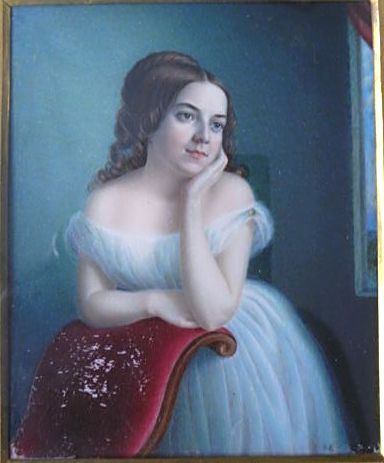
The photos displayed here, while illustrating the skill of the artist, do not convey the depth of colors and the vibrancy of the miniature when viewed in the hand or under a magnifying glass. It is 95mm x 77mm and contained within a leather case.
 The portrait has moved straight to the top echelon of my personal favourites among the American miniatures in this collection.
I feel the actual painting skill is similar to that displayed by John Henry Brown. However Brown was trying to emulate photographs and his miniatures tend to be flat, whereas this miniature was painted just before the introduction of photography and has a depth that very few other miniature painters have equalled.
Unfortunately, the name of the sitter is unknown, although the previous owner has believed it had probably been in a drawer in the same house in Raymond, Maine since before 1880.
If any of the occupants of the house at that date had been known, it may have been possible to back track through census records to determine the likely sitter.

 The skill of the artists can be seen in the close ups of the head, her wrap, and her hands. It is almost possible to read the writing on the letter she is holding.
The miniature is clearly signed on the reverse "D and M L Wagner December 1839". Above the signature there is an earlier erased signature which is indecipherable. It appears to start "By Daniel ......." but there are two interpretations.
Firstly, that it read "By Daniel Wagner" but then it was amended to include his sister's name.
Secondly, that it may have read "By Daniel and Maria Louise Wagner" but the wording was then found to be too long to fit on the reverse of the miniature when the paper was cut down to size and so the signature was rewritten to fit the piece of backing paper.
This is one of over a dozen American portraits in the collection, from around 1830-35, all depicting young ladies wearing a "little black dress", and thus indicating the 19C origin of the proverbial fashion item, of a "little black dress" usually claimed as being in the 1920's.

In August 2015 there has been a very interesting development with respect to the miniature portrait depicted here.As included much further below I have been contacted by a descendant of the Wagner family who has several oil portraits by Maria Wagner. On of them is of Miranda Wagner, Maria's sister-in-law. The visitor has suggested there such a close likeness, that this miniature is also of Miranda Wagner.
I must say with great gratitude that I agree with that opinion, and have therefore altered the title of this post to record her name, instead of "portrait of a lady". It is rare to be able to give an unidentified sitter back their identity, but it is very satisfying to do so.
 Since the miniature was first listed here, more has been discovered about the lives of Daniel (14 Apr 1802- 21 Jan 1888) and his sister Maria Louisa Wagner (1815-20 Oct 1888) and added below. Daniel was born in Leyden, MA and worked in Utica NY, Albany NY, NYC and died in Norwich NY.
They have been found in the 1880 census record which shows Maria Louisa as born in NY state, elsewhere she is recorded more precisely as born at Preston, Chenango, NY in 1815. She worked in Chenango Valley, NY, Albany NY, NYC and died in Norwich NY in the same year as her brother. Maria Louisa is buried at Mt Hope Cemetery,Norwich, NY.
 In the 1880 census, they are recorded as living in Rochester NY, Maria as 62 years old and with no occupation, but Daniel describing himself as 78 and as "portrait and landscape painter". They record both their parents as born in Massachusetts. Daniel is not referred to as crippled, despite the references below to him being crippled.
Their father was Frederick Wagner (1777-16 Jul 1868) who had been born in Worcester, MA, son of John Frederick Rudolf Wagner born on 19 May 1778 in Worcester, whose parents were Caterina Elizabetha Wagner and Johan Jacob Wagner. Their mother was Anna Walworth.
 Frederick Wagner married Anna or Hannah Walworth (21 May 1778-6 Sep 1847) who had been born in Leyden, Franklin, MA. They were married on 03 Jan 1799 at Leyden, Franklin, MA and had 13 children, of which Daniel was the eldest of four sons, and Maria Louisa was the seventh of nine daughters.
The reverse of the ivory shows how some artists added depth to their work. In comparing the reverse with the front, it can be seen that the dress, necklace, and hair are different. Presumably, at the request of the sitter.
Among American miniature painters there are very few examples of miniatures being jointly signed. Other examples include; "Inman and Cummings" and "Doyle and Williams". However, the Wagner's seem to be unique as signing as brother and sister.
 According to Women's Culture: American Philanthropy and Art, 1830-1930 - Google Books Result Maria took up miniature painting to help care for her crippled brother.
Other works by them seem to be rare. The only one I can find is a reference to this portrait of Henry Rowe Schoolcraft by Maria Louisa Wagner, which is inscribed on the reverse "Painted by/Mary Louis Wagner/Washington ["Albany" is crossed out] /June 1852/The Property of Ester Schoolcraft." This seems to suggest that they also worked as individuals.
The year 1839 that this fine miniature of a lady by Daniel and Maria Louisa Wagner was signed, is poignant in the history of miniature portraits, as it is the year before the introduction of daguerreotypes began to hit miniature painters like a tsunami.
Thus 1839 could be said to represent the high tide mark for American miniature painting. This miniature certainly deserves to be regarded as a worthy example to mark that high tide. 1322

 Subsequently, the following extra information has been found out. "Daniel and Maria Louisa Wagner, were a brother and sister team from Norwich, New York who travelled from town to town in a covered wagon painting portraits and miniatures.
 One day they met the great William H. Seward in Ithaca, NY who later became Governor of New York. He was so taken with their work that he advised them to open a studio in Albany, NY.
They soon won acclaim among the elite, painting portraits of many famous people of the day...Martin Van Buren, Erastus Corning, Silas Wright, Millard Fillmore, and many others.


Showing here is a partial list of the portraits they painted. A larger list is now held as part of the Chenango County museum. Also showing are some newspaper articles about the Wagners.
"Some commentators proclaimed the two country children to be "THE WORLDS GREATEST PAINTERS OF MINIATURES" In 1852 upon the advice of Mr. Fillmore, the two headed to Washington, DC. There they made paintings of Daniel Webster, President Fillmore's family, and a great many other notables. Then they went to New York City where they opened a studio.
Throughout their entire lives the brother and sister remained inseparable. They returned to their home town of Norwich, New York in later years where Daniel Died in Feb. 1888, and his sister died a few months later apparently of grief at the loss of her brother. They are buried side by side in Mt. Hope Cemetery in Norwich."
A kind visitor found the miniature by Daniel and Maria Wagner in this collection and has sent in for display another miniature by Daniel Wagner. Wagner painted this one of his niece, Altheda Sheffield (Phelps) at age 14 in 1840. She was the great-great-grandmother of the visitor.
 For those interested, the visitor was able to provide more information about the Wagner family. There were 13 children, with Daniel being the third and Maria the eleventh. The following obituary is from an 1888 newspaper clipping found at the Gurnsey Memorial Library in Norwich, New York. As there is little information readily available about the Wagners, it has been repeated here in full for any interested family or art researchers.
"Death of Daniel Wagner
At his home on Hayes St, Saturday evening, Mr Daniel Wagner the well known artist died at the advanced age of 86 years. As noticed in a former issue he had a shock of paralysis about two weeks ago. He was too feeble to rally after lingering till Saturday evening quietly passed away. He was born at Layden Mass. April 14, 1802 and removed to this town with his parents in the fall of 1805. At sixteen years of age he was a well grown youth five feet ten inches high a well proportioned and could out work, out run or out jump any one of his age. In those days, farmers had all their own grain ground at the mills near by, and boys went to mill evenings so as to be in school in the day time.
One evening he went to mill with grain, and having to wait his turn, played a game of "goal" with the other boys. When his grist was brought out, though in a great perspiration, he placed the grist on his horse and rode nearly two miles, in the teeth of a northwest wind. He took a severe cold which settled in his right hip joint. He was treated with "calomel and jallop and freely bled." He suffered intense pain and his right leg contracted about three inches. Drs. Mitchell and Packer were called in consultation and pronounced his disease "acute hip disease." Dr. Mason, who had just been Chenango’s Representative in Congress, was also consulted and gave it as his dictum that his patient might live three months.
Despite the prophecies of the physicians, he rallied and could move on crutches. Then the socket joint of the left leg was attacked and that hip thrown out of joint. He was confined to the bed for a year by this trouble. He finally recovered so as to be able to get about with short crutches.
While in this crippled condition he began to sketch the heads of his friends for amusement. He soon found he had decided talent for drawing giving individuality. His friends soon began to insist upon keeping his sketches and paying him for them. One day he was a guest in a home where the daughter had just returned from boarding school and had a box of water colors. She taught him how to use them and he colored a head of her, with which she was greatly pleased. Going to Oxford soon after he saw a portrait of a beautiful lady by Rembrant Peale. He copied it in oils with gratifying success.
He then began to teach his sister, Miss Louise Wagner, the details of drawing and gave her the head of "Thomas Jefferson," to copy. She succeeded so well that they determined to pursue art. About this time he was confined to his bed for a year, but, his health slightly improving , he began to paint miniatures "lying on his back and having his sitter beside his bed. His sister having decided to devote herself to the same line of art, they spent several years painting portraits in the towns of Chenango Valley, going as far south as Binghamton and north to Utica and Whitestown and west to Ithaca. At the latter place the became acquainted with William E. Seward and under his advice went to Albany, where they painted miniatures of the members of legislature. From Albany they went to New York taking letters of introduction.
From a short autobiography we take the following, "We took rooms at the Astor House and being lame I sent my letters to those for whom they were intended. Among them was one Newman the bookseller. He called, looked at our specimens, pronounced them excellent but said he - "I fear there is one thing you lack to succeed well in New York and that is brass. My motto is that brass is gold in New York. You must keep a brass candlestick by you and rub your face morning and night till you get brass enough for New York. Then you will succeed."
Among the New York visitors was Dr. Valentine Mott, the great surgeon. He examined Mr. Wagner and pronounced his case one of the most remarkable he had ever seen. "I have never known," said the great surgeon "one to live through a dislocation of both hips."
From New York, the brother and sister returned to Albany, where they painted portraits of Erastus Corning, Martin Van Buren and Silas Wright. In 1848 the painted Vice President Millard Fillmore. In 1853 they went to Washington and painted the family of President Fillmore, visiting the White House and attending the receptions. They painted many Congressmen and Daniel Webster, then Secretary of State.
Returning to New York they established a studio in the Dodworth Building and took a landscape painting in oils. They made studies on the Hudson and in the Adirondacks. Some of these paintings were exhibited at the Centennial. About 1870 they returned to this village, where they have resided since. Mr. Wagner was a very pleasant and interesting man to meet. His struggle and victory over the disease which made him almost a helpless cripple for sixty years was as remarkable as pathetic. His sister who has been his inseparable companion all these years, is left to mourn her great loss.
His funeral was attended Monday afternoon from the residence of Elmore Sharpe, Esq, on Hayes Street whose wife is a niece of the deceased where Mr and Miss Wagner have made their home for several years. Rev A J Van Cleft officiated and made some most appropriate and excellent remarks.


Another kind visitor has also sent images of a nice miniature by Daniel Wagner, signed and dated Albany Jan'y 1845.
It is interesting to compare the signature with the one above. The word Wagner seems a little different and hence it appears one signature is by Maria Louisa and one is signed by Daniel.
The case containing the portrait is engraved on the reverse "John J P de Puy", but so far the owner has not been able to find out more about John de Puy.

 Later - The owner has now advised this information;
I've been able to find a bit more about Mr. De Puy. Basically, as the Web has grown, and more texts are added, things appear that didn't even a year or two ago. It appears he was a member of the New York State Legislator for just one year, 1845, representing New York City. So, he must have had the miniature done when he was serving at the Capitol in Albany. He was listed as an "American Republican" party member, a short-lived Nativist minor party which swept the NYC election in 1844. They later became part of the "Know Nothing Party". However, in 1848 he's mentioned in the newspapers as Chairman of the Democratic Whig Young Men of New York City, and then in 1850 I find him in San Francisco as Chairman of the local Whig Party. So, he probably moderated his views as the Whigs were a more liberal party, in modern terms. Finally, I find a "J. J. R. De Puy" of New York as a minister of the Methodist Church......maybe him, maybe not.
Later - yet another kind collector has provided a photo of a further miniature portrait by Maria Louisa Wagner. It is of a young lady and is signed and dated on the backing paper "Painted by M Louisa Wagner Albany Nov 1847".
 The miniature is another example of the excellent work of this artist and in a relaxed, informal pose.
There is some paint loss on the red chair, as is the case with red area in her other portraits. At this time artists often mixed their own colors and hence it seems Maria had difficulties in striking the right mix of ingredients for the color red.
 August 2015 - I have received a great deal more information about the Wagner family from a descendent.
They have advised as follows:
 |
| Anna Farnsworth Wagner, |

 |
| John Jacob Wagner III, |
We have long wondered how such an accomplished painter could have flown under the radar and have conducted occasional searches for information about Ms. Wagner since the internet became available.
Your information is the first we have found, and it has given us a great deal of new information about our ancestry, and about the painter and the story of her brother.
There are some inconsistencies between the information we possess and what you provide, but we may very well want to chalk that up to less than accurate records, distance, and the passage of time. For example we have always believed that Ms. Wagner’s father was John Jacob Wagner III, while your research indicated that their father was named Frederick.
 |
| John Jacob Wagner IV, |
As to that point, infant mortality being what it was, that detail does not cause us to believe that the artist you wrote of, and the one that painted our paintings is not one and the same.
While she may not have painted Lincoln’s portrait, as we have long been led to believe, her introduction to William Seward and the record of portraits of notables from our nation’s capital that your research indicates were painted by the brother and sister is an area of consistency.
The dates on our portraits is consistent with her life span, and the time during which one might expect both she and her brother to have painted with the most proliferation.
 |
| Miranda Wagner |
At any rate we invite you to compare the two and we welcome your thoughts and any additional information you can provide. We would very much appreciate learning of your source information for the research you conducted about the Wagners, we hope there is much more to learn about the family.
I look forward to hearing from you,
This is the comparison of the two images that he sent me. I replied to Mark as below and he kindly agreed I could post the above information here for the benefit of other people interested in the Wagner family. Many thanks for your kind comments and all the extra information. I am glad that the information I had accumulated at 3 American Miniature Portraits: Wagner, Daniel and Maria ... was of use to you. The whole purpose of the website was to try and add to the public record, information about "forgotten" artists and sitters, so that their lives were in fact not forgotten! [ Perhaps a sort of artistic, "Who Do You Think You are? ! ]
Other than where I mention that the information came from a visitor to the website, the information was collected from the Internet via various "trial and error" name combinations, or from www.ancestry.com Both often tedious processes! - but which did uncover odd "nuggets". However, even there I may have made the odd error.
While I am unable to guarantee the accuracy of any information provided by visitors which differs from your own information, I happily accepted that it was given by those visitors in good faith. Hence, there is probably an opportunity for you to undertake more detailed research and to hope to reconcile them.
I have not checked the relative ages of the paintings with her age at the time, but do agree with your wife that the portrait in the miniature is very likely Miranda Wagner. The quality of that miniature is exceptional, so the attention given to the detail becomes explainable by it being of a close relative. (There are in the collection a few miniatures by other artists, of a single sitter at different ages, and it has amazed me how well paintings can convey a person's likeness at different ages.)
March 2018
I have received much good information about the Wagner family from a very kind family descendant who advises as below. I have not tried to integrate the information with that above, as I think it would be inevitable that I make mistakes. Thus feel it is better just to thank that kind visitor and add her information as below.


2 comments:
A friend of mine has found an Miniature Portrait signed by the brother and the sister. It is in a case that has Rev John Harvey as the subject. Dated Dec 1839. What do you think this might be worth?
I regret I only enter into correspondence of this nature with people willing to contact me by email via my profile and hence do not give valuations to anonymous visitors.
Post a Comment